

HealthTech software development
Digital health products built on data that actually connects
ABM Technologies works with healthcare technology teams and HealthTech founders on patient, member and provider experiences, systems integration and long-term application support.
- Who we work with
- Healthcare technology leaders, digital-product teams, integration teams, HealthTech founders, administrative-technology teams
- Typical engagements
- Digital-health product development, systems integration, API and data workflows, managed application support
- Claims posture
- FHIR, HIPAA and interoperability terminology used only where ABM has verified the capability
Main challenges
What makes healthcare technology work different
The record is spread out
Clinical, claims, scheduling and administrative systems each hold part of the picture, in different formats and cadences.
Experience expectations rose
Patients and members compare healthcare interfaces to consumer apps, including on accessibility and mobile.
Privacy shapes architecture
Where data lives, who can see it and how long it is kept are design constraints, not deployment details.
Products must keep running
Once a platform carries care or coverage workflows, support and release discipline matter more than new features.
Relevant capabilities
Capabilities applied to healthcare products and platforms
Digital-health product development
From validated concept to production platform, built with the operational team that will run it.
See Our Custom Software ApproachPatient, member and provider experiences
Task-focused, accessible interfaces for the people using them under time pressure.
Learn About Accessible UX DesignHealthcare systems integration
Connect clinical, claims, scheduling and administrative systems with monitored, documented interfaces.
Read the Healthcare Integration ApproachAPI and data workflows
Reliable exchange and transformation pipelines, with error handling designed for data that arrives imperfect.
See Our API Integration ApproachInteroperability engineering
Standards-based exchange where the systems support it. Specific standards named only where ABM has verified experience.
Learn About Interoperability WorkManaged application support
Monitoring, incident response, upgrades and integration maintenance for platforms already in production.
Learn About Managed Technology Services
Audience pages: Digital Product Development · Systems Integration & Data · Trust, Privacy & Security
Common use cases
Where engagements usually begin
- Building a patient or member portal on top of several existing systems
- Replacing manual file transfers between an administrative system and a partner platform
- Taking a HealthTech product from prototype to a supportable production platform
- Consolidating provider-facing tools into one workflow
- Adding reporting across clinical and administrative data sources
- Assuming support and improvement of a platform with no dedicated engineering team
Delivery approach
How we run the work
Understand
We map the systems, the people who depend on them and the constraints you actually work within — procurement, policy, budget cycles.
Design
We agree the target architecture and the user experience, then prove the risky parts early with prototypes rather than documents.
Build & Integrate
Delivery happens in reviewable increments, with integration to existing systems treated as part of the build, not a final step.
Operate & Improve
We monitor, support and keep improving what is live, and we document it so your team can run it without us.
Security, privacy & accessibility
How we handle privacy, security and responsible healthcare AI
What we practice today, described plainly, as working standards rather than formal certifications.
Privacy by architecture
Minimum necessary data, explicit retention and documented movement between systems, agreed before implementation.
Security practices
Least-privilege access, encryption in transit and at rest, dependency scanning and change control. No compliance certification is claimed here.
Accessible healthcare experiences
WCAG 2.2 AA as the delivery target for patient, member and provider interfaces, verified with assistive technology.
Responsible healthcare AI
Documented purpose, human review of consequential output and no model training on client data without written agreement.
Relevant case studies
Work in HealthTech
 HealthTech
Aster DM Healthcare
- Problem
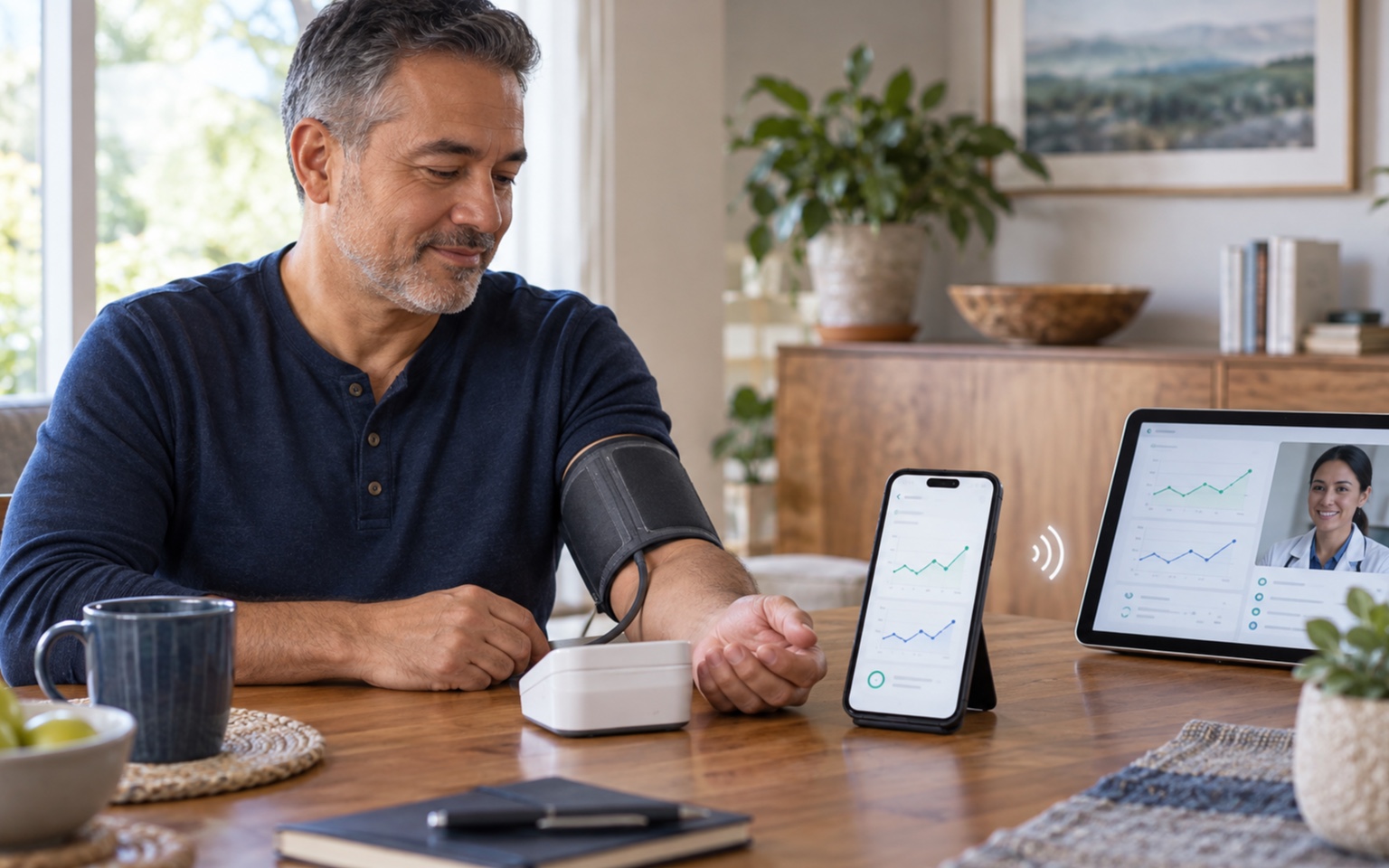
- Aster DM Healthcare wanted patients enrolled in its Aster Chronic Care program (diabetes, hypertension and other chronic conditions) to track their health from home, but needed reliable communication between Bluetooth medical devices and mobile phones, first-mover speed to market, and a product ready to scale to millions of existing Aster Healthcare customers.
- Verified result
- Patients can track and analyze blood-pressure and glucose readings directly in the app; intelligent business reports help doctors reach a more accurate diagnosis; and the platform integrates with BP and blood-glucose devices from other manufacturers.
Related resources
Further reading

HealthTech
Healthcare interoperability in practice
How integration work actually lands when clinical, claims and administrative systems each hold part of the record.
Promit Mitra · Updated 2026-08-19

Cross-sector
Responsible AI in regulated industries
Governance that survives audit: documented purpose, data lineage, oversight and a way to turn it off.
Nikita Katiyar · Updated 2026-08-19

Cross-sector
Accessible digital services: a delivery checklist
What to test at design, build and release so accessibility is not discovered during procurement review.
Udita Madan · Updated 2026-08-19
Talk through a healthcare product or integration
Describe the systems involved and what has to be true for patients, members or providers. We will be direct about what is straightforward and what is not.